Your Traditional SEO Playbook Is Quietly Losing Ground. What Smart Founders Are Doing Next.


By Adrian Maynard, Founder of Yo Marketing
For the last decade, the digital growth playbook was predictable. You researched high-intent keywords, published optimized content, built backlinks, and watched your organic traffic climb. If you owned the top three blue links on Google, you owned the category.
That era is over.
Today, your best prospects aren't just scrolling through ten blue links. They are asking AI engines (ChatGPT, Perplexity, Gemini, and Google’s AI Overviews) to compare vendors, shortlist agencies, and recommend solutions before they ever visit a website. When a buyer asks an AI model, "Who is the best partner for {your category}?" there is no page two. Either your brand is cited as a trusted authority, or you are invisible.
As the founder of Yo Marketing, I spend my days looking at where growth actually comes from, not where it came from three years ago. And right now, the biggest blind spot I see on executive dashboards is a false sense of security around legacy SEO metrics.
The Illusion of "Healthy" Organic Traffic
Many companies are still celebrating steady keyword rankings while their qualified pipeline quietly softens. Here is why:
• Zero-click discovery is the new default. Buyers get synthesized answers directly inside AI interfaces. If your brand isn't part of the model’s synthesis, traditional impressions won't save you.
• Keywords matter less than entity authority. Large language models don't just match strings of text; they map relationships between brands, problems, proof points, and third-party credibility.
• Technical debt blocks AI crawlers. Sites built strictly for legacy search crawlers often lack the clean semantic structure, schema, and clear positioning that AI systems rely on to extract and cite accurate facts.
If your marketing team is still measuring success solely by traditional rank trackers, you are optimizing for a shrinking slice of buyer attention.
Winning the AI Search Layer Requires a Different Lens
Transitioning from traditional SEO to AI-first search visibility isn't about throwing away everything you’ve built, it’s about recalibrating how machines read, trust, and recommend your business.
At Yo Marketing, we approach AI search readiness across three core pillars:
1. Brand & Entity Clarity: Does an AI engine clearly understand what you do, who you serve, and why you win, or is your positioning diluted across inconsistent pages?
2. Citation & Authority Signals: Are credible third-party sources, structured data, and authoritative content reinforcing your expertise across the web?
3. Technical & Content Readiness: Is your site structured so AI retrieval systems can parse your value propositions cleanly without hallucinating or skipping over your core offers?
Most founders don't need another 80-page agency deck full of vanity metrics. You need a clear, prioritized diagnostic of how AI search engines currently perceive your brand, and a practical roadmap to fix the gaps.
See How AI Engines Actually View Your Brand
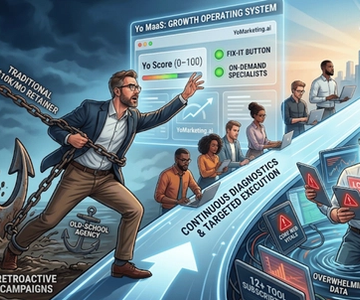
That exact gap is why we built Yo MaaS (Marketing-as-a-Service), to pair senior strategic thinking with fast, repeatable execution that moves the needle without bloated retainers.
Before you commit another dollar to legacy content production, find out where you actually stand in AI-driven search.
Run your Yo MaaS AI SEO Audit to uncover how AI search engines currently interpret your brand, where competitors are out-citing you, and the highest-leverage moves you can make right now to own your category.