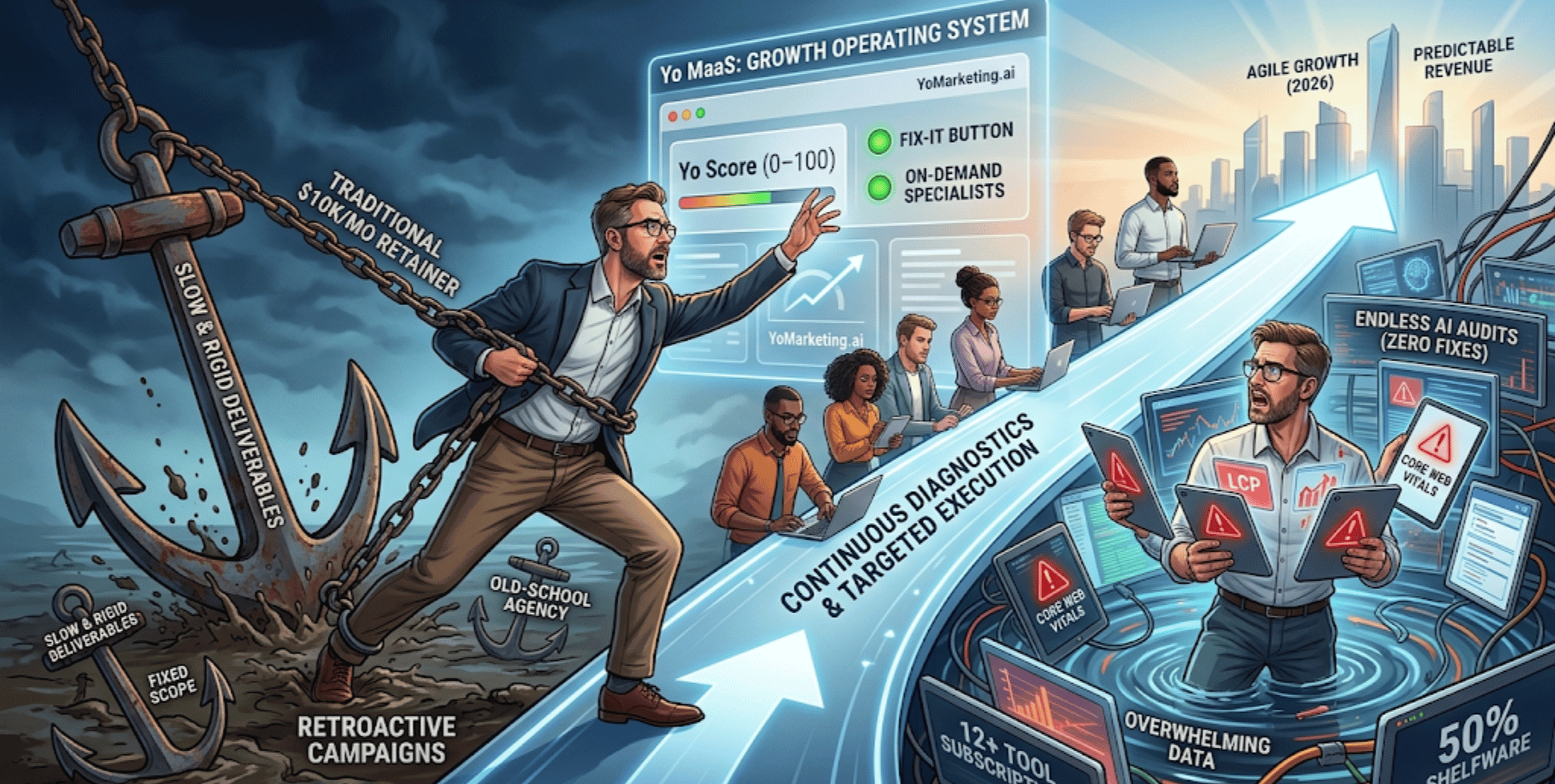

Escaping the Great Marketing Trap: Why the Future of Growth Isn’t Another Hire or Retainer

StrategyWebsite
Single Media

By Adrian Maynard, Founder of Yo Marketing

For years, senior leaders at SMBs and mid-market companies have faced an exhausting dilemma when trying to scale revenue.

You need brand visibility, performance optimization, strategic positioning, and technical execution. But the standard playbooks for acquiring those capabilities are fundamentally broken.

Marketing leaders and founders are getting caught in The Great Marketing Trap, pinned between two equally frustrating extremes that bleed budgets and stall momentum:

Extreme 1: The "Retainer Anchor"

You hire a traditional agency on a $10,000 to $15,000 monthly retainer. You get sold by the senior partners, only to be handed off to junior account managers.

Worse, you’re locked into rigid scopes of work: four blog posts, two social graphics, and a monthly status call. When consumer behavior shifts, search algorithms pivot to generative AI overviews, or conversion rates suddenly drop, your agency is still grinding through last quarter’s deliverable checklist. You’re paying enterprise prices for yesterday’s roadmap.

Extreme 2: The "Software Swamp"

Determined to stay nimble, you turn to technology. You subscribe to an SEO crawler, an AI copywriter, a heatmapping tool, a competitive intelligence platform, and a social scheduler.

Suddenly, your team is drowning in logins and dashboards. You get endless automated audit notifications telling you what is broken, from "Poor LCP" to "Missing Schema" and "Keyword Cannibalization." But finding a problem isn’t the same as fixing it. These tools hand you a 40-page checklist of digital ailments, wish you luck, and offer zero hands-on execution.
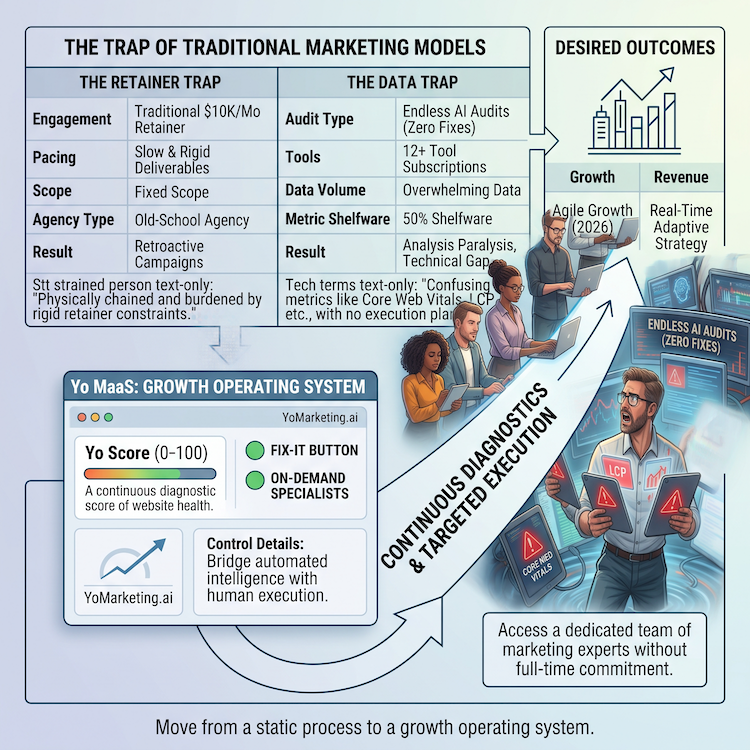
Move from a static process ot a growth operation system

The Hidden Casualties: Shelfware & The "Salary Trap"

When you bounce between retainer anchors and software swamps, two predictable crises emerge:

1. The Shelfware Explosion: Over 50% of purchased marketing software quietly turns into "shelfware", or unused, unintegrated tools running in the background while team members revert to manual workarounds.

2. The Salary Trap: To bridge the gap, leaders often say, "Let's just hire an in-house Growth Director." But the true cost of a senior hire is typically 40% above base salary once benefits, taxes, bonuses, equipment, and recruiting fees clear.

Even if you make that hire, one person cannot be five specialists. Your strategic director is not also a technical full-stack developer, a CRO specialist, a paid media buyer, and a high-converting copywriter. You burn through $180,000+ per year and still lack the hands required to ship campaigns.

Growth Is Not a Project, It’s a Continuous Diagnostic Process

Marketing has evolved past quarterly campaign pushes and annual redesigns. In a landscape reshaped by AI search, rapid algorithmic updates, and fragmented buyer journeys, growth cannot be treated as a collection of one-off projects.

Growth is a continuous diagnostic loop:
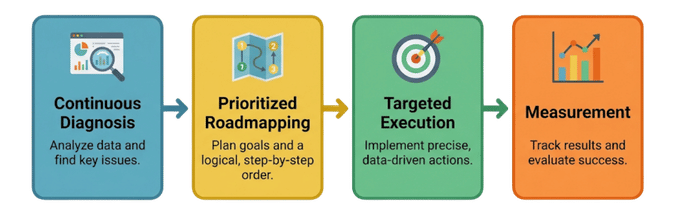
Growth is a continuous diagnostic loop

The companies winning aren’t the ones carrying the largest departments or the heaviest payrolls. The winners are the most agile. They detect bottlenecks in real time, prioritize them ruthlessly by business impact, and deploy specialized talent immediately to resolve them.

Enter Yo MaaS: The Growth Operating System

To dismantle the trap, we built Yo MaaS (Marketing-as-a-Service), a unified Growth Operating System that bridges the canyon between automated intelligence and human execution.

Rather than giving you another dashboard to monitor, Yo MaaS pairs smart diagnostic technology with the Yo Marketing fractional team of veteran specialists.
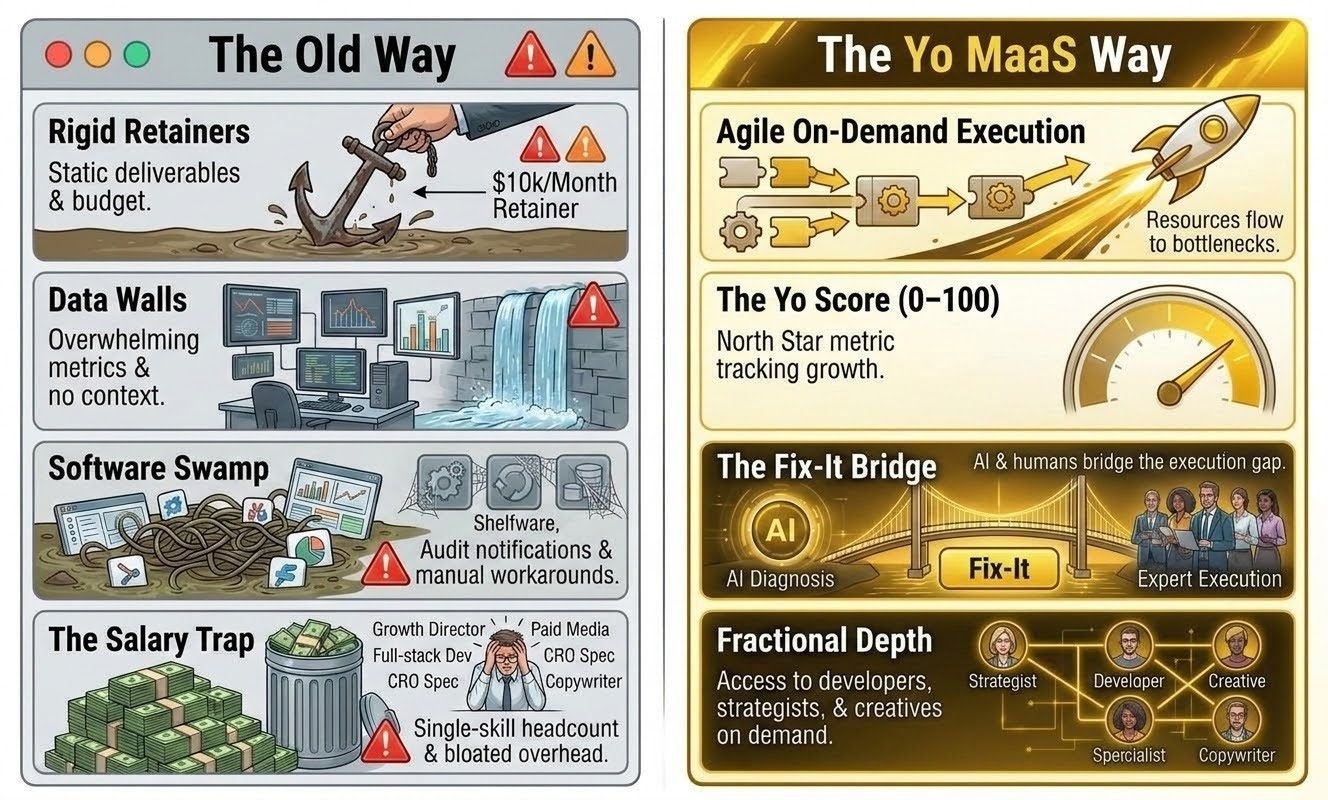
The Old Way vs The Yo MaaS Way

How It Operates

Instant Diagnostic Clarity (The Yo Score): Our diagnostic engine continuously scans your digital footprint across performance, SEO/AIO, mobile experience, brand positioning, and security. It translates technical jargon into a single, weighted Yo Score (0–100).

The Action Stream: Instead of hundreds of warning tickets, Yo MaaS surfaces a prioritized punch list ranked by Effort vs. Impact, showing exactly what to fix first to capture pipeline.

Frictionless Execution: You never have to wonder who will do the work. Implement fixes internally with guided instructions, or hit the Fix-It button to deploy Yo Marketing’s fractional team directly from the platform.

Stop Guessing. Start Growing.

If your marketing budget is tied up in retainer handcuffs, underutilized AI subscriptions, or an overloaded internal team trying to wear ten hats at once, you don't need more software. You need a system that diagnoses what matters, filters out the noise, and helps you execute with surgical speed.

Curious where your digital presence stands?

Discover your baseline and see where your revenue leaks are hiding.

👉 Get Your Free Yo Score at Yo MaaS!

Get Your Free Yo Score Today


Relevant Posts
All Blog Posts
Blog

Why 2025 Belongs to Customer Marketing

By Sarah Taylor, Yo Marketing Agency Head of Global Events As we head deeper into 2025, a quiet shift is reshaping the way marketing teams operate. It’s not about flashy lead gen tactics or ever-larger acquisition funnels anymore. The most forward-thinking businesses are asking a different question: How do we get more value from the customers we already have? ### Budget Cuts and Strategic Shifts With many marketing budgets under pressure, companies are re-evaluating how and where they invest. For a long time, growth was synonymous with acquiring net-new leads. But in today’s landscape, where CAC (customer acquisition cost) is climbing and conversion timelines are stretching, executives are doubling down on a more efficient path to growth: customer marketing. In fact, while many demand gen roles are being frozen or cut, there’s been a noticeable uptick in investment for customer advocacy, lifecycle marketing, and community-led programmes. These aren’t just tactical roles; they’re becoming the backbone of a more sustainable growth strategy. ### It’s More Than Just Upselling Let’s be clear: this isn’t about squeezing more revenue out of existing clients. The shift is much bigger than that. It’s about: • Creating genuine brand advocates • Showcasing customer success as proof of value • Building deeper loyalty that leads to repeat business and referrals Customer marketers are becoming the storytellers of the business, spotlighting real-world results, amplifying trusted voices, and helping prospects see what’s possible through the lens of existing success. ### Advocacy Over Acquisition When done right, your happiest customers become your most powerful marketing channel. They bring credibility, reduce sales cycles, and build trust in a way no campaign or cold call ever could. And the beauty is, you’ve already done the hard part – they chose you. Now it’s about nurturing those relationships and building a platform for them to tell their story. In 2025, the smartest marketers aren’t chasing attention. They’re earning trust. If you’re ready to turn your customers into your most valuable marketing asset, Yo Marketing can help. We design and deliver customer-led programmes that build loyalty, drive referrals, and create stories that sell. Let’s talk! [![Schedule a free strategy session today](https://8pfraw1pqsd9gr2m.public.blob.vercel-storage.com/cta/schedule%20a%20free%20strategy%20session%20today-71nxI8IjipsNWn5HZlezFcxibVvXHd.png)](/contact/)

Icon

Read more

Blog

Unlock B2B Growth: The Power and Strategy of Account-Based Marketing

By Nick Veneris, Yo Marketing Agency Director of Digital Strategy & Growth In the competitive landscape of B2B, finding efficient ways to drive significant growth is paramount. While broad marketing strategies have their place, Account-Based Marketing (ABM) is emerging as a powerhouse for companies targeting high-value clients. It’s not just a buzzword; it's a strategic approach proven to deliver substantial results. In fact, [87% of B2B marketers report that ABM outperforms](https://www.terminus.com/state-of-abm-report/) other strategies in ROI, and companies using ABM can generate 208% more revenue for their marketing efforts. This post dives into why ABM is a game-changer for B2B companies, exploring its core benefits, strategic goals, effective strategies, and how to approach implementation. #### What Exactly is Account-Based Marketing? At its heart, ABM is a highly focused B2B strategy where marketing and sales teams collaborate closely. Instead of casting a wide net hoping to catch leads, ABM identifies specific high-value companies (accounts) that are the best fit for your products or services. Resources are then concentrated on engaging these target accounts with personalized campaigns tailored directly to their unique needs, challenges, and position in the buying journey. It’s about quality over quantity, depth over breadth. #### The Compelling Benefits of ABM for B2B Companies Why are so many B2B growth teams prioritizing ABM? The advantages are clear and impactful: **1. Superior ROI and Revenue Generation:** As highlighted, ABM consistently delivers higher returns compared to other marketing strategies. Focusing resources on accounts most likely to close drives significant revenue growth. **2. Increased Precision and Efficiency:** ABM eliminates wasted spend on audiences who aren't a good fit. By concentrating efforts on predefined high-value accounts, marketing resources are used far more effectively. **3. Enhanced Customer Lifetime Value:** ABM isn't just about acquisition; it's about building deep relationships. This focus leads to better engagement and significantly higher customer retention rates (companies using ABM see a 36% higher rate). **4. Faster Sales Cycles:** Personalized engagement and sales/marketing alignment mean target accounts move through the pipeline more quickly. ABM users report a 27% faster deal cycle. **5. Improved Sales and Marketing Alignment:** ABM necessitates collaboration. Both teams must agree on target accounts, develop messaging, and coordinate outreach, leading to a unified approach and more qualified opportunities handed to sales. **6. Deeper Account Penetration:** ABM allows you to map out and engage multiple stakeholders within a target account, increasing the chances of closing complex B2B deals. **7. Real-World Results:** The strategic focus of ABM isn't just theoretical; it translates into measurable business impact. By concentrating resources on high-value accounts and delivering personalized engagement, companies consistently see improvements in pipeline velocity, deal size, and overall revenue contribution from their most important clients. To see a tangible example of how a well-executed ABM strategy can yield significant outcomes, [read our case study](https://yomarketing.agency/blogs/case-study-yo-marketing-drives-pipeline-growth-for-workforce-analytics-platform-with-strategic/). This provides concrete proof of ABM's effectiveness in driving real growth. #### Key Goals Driving ABM Strategies Companies adopt ABM to achieve specific, high-impact business objectives: **Land High-Value Enterprise Deals:** Focusing resources on the biggest opportunities. **Increase Average Deal Size:** By understanding account needs deeply and cross-selling/up-selling effectively. **Improve Pipeline Velocity:** Moving key accounts from identification to close more quickly. **Build Strong, Lasting Client Relationships:** Turning key accounts into long-term partners. **Enhance Sales & Marketing Synergy:** Creating a seamless, collaborative GTM motion. **Boost Revenue from Target Accounts:** Directly attributing marketing efforts to closed business within the most important segments. #### Core ABM Strategies & How to Approach Implementation Getting started with ABM involves a structured approach: **1. Identify Your Ideal Customer Profile (ICP):** Analyze your best existing customers. What industries, company sizes, technologies used, or pain points do they share? Define what an ideal target account looks like. **2. Select Target Accounts:** Build a focused list of companies that fit your ICP. Use firmographic data (industry, size, location), technographic data (technologies they use), and intent data (signals indicating they are researching solutions like yours). Keep the list manageable and focused. **3. Research and Personalize:** Deeply understand the selected accounts. Identify key stakeholders, business challenges, and strategic goals. Map out the buying committee. **4. Create Tailored Content & Messaging:** Develop marketing assets (emails, case studies, presentations, ad creatives) that speak directly to the specific needs, industry, or personas within each target account. Generic messaging won't work. **5. Orchestrate Multi-Channel Engagement:** Coordinate outreach across various touchpoints. This includes personalized emails, targeted digital advertising (like LinkedIn ads), social media engagement, direct mail (if appropriate), and coordinated sales outreach. **6. Align Sales and Marketing Activities:** Constant communication is key. Ensure both teams know the engagement plan, share insights, and work together on follow-up. **7. Measure, Analyze, and Optimize:** Track progress based on ABM-specific metrics. Focus on account engagement levels, pipeline influence (how many target accounts enter the sales pipeline), deal velocity, and ultimately, revenue generated from the target account list. Use insights to refine your approach. Implementing these steps requires a practical mindset focused on consistent effort rather than quick fixes. For a deeper look into crafting a realistic and effective plan, explore [Forget Magic Bullets: The Real ABM Strategy for B2B Success](https://yomarketing.agency/blogs/forget-magic-bullets-the-real-abm-strategy-for-b2b-success/). #### Measuring What Matters in ABM Success in ABM isn't measured by vanity metrics like clicks or impressions. Instead, focus on business impact: Pipeline contribution from target accounts Account engagement scores Deal velocity for target accounts Closed revenue from the ABM list Customer retention rates for ABM accounts #### Final Thoughts: ABM for Focused B2B Growth ABM is a powerful strategic choice for B2B organizations aiming to secure high-value deals, cultivate long-term customer relationships, and ensure their sales and marketing efforts are perfectly synchronized and maximally efficient. If your business involves complex sales cycles, high-ticket solutions, or a desire to deepen relationships with key clients, integrating ABM is no longer optional—it's essential for sustained growth. [![Schedule a free strategy session today](https://8pfraw1pqsd9gr2m.public.blob.vercel-storage.com/cta/schedule%20a%20free%20strategy%20session%20today-71nxI8IjipsNWn5HZlezFcxibVvXHd.png)](/contact/)

Icon

Read more